Friday, 24 May 2013

How the world reported terror on London streets

The brutal killing of Lee Rigby in Woolwich has outraged Britain. Every British national newspaper led on the event yesterday and the photograph of Drummer Rigby graces every front page today. But how did newspapers from other countries react to the murder? Do they believe this new approach to terrorism has global implications relevant to their readership, is it such a shocking and horrific story that it demands a place on Page 1 or is the killing of a single British soldier not regarded as significant? Here's a quick snapshot of some of the globe's front pages. Surprisingly, the US newspapers largely ignored it. Perhaps in the wake of the Oklahoma tornado deaths, the killing of one young soldier 7,000 miles away, albeit in such a shocking way, is not regarded as important. 


The Wall Street Journal uses the story but as a single column, headlined 'A killing puts UK on guard for terror' and the New York Times believes it is worth no more than a down-page cross-reference. 
Today's Washington Post leads on a terror story - 'Obama points to crossroads in terrorism fight' - but makes no mention of the UK. It does not even warrant a paragraph in the global round-up at the bottom of the page.


The only regional newspaper, outside of New York, I could find that believes it to be of Page 1 importance is The News-Sentinel in Indiana.


The New York tabloids, though, clearly think it is shocking enough to wipe out their pages and the New York Post uses a picture of Lee Rigby on Page 1 today too.


The National Post in Canada also uses the killing as the lead and main photograph. 


In the Middle East few mainstream papers appear to believe it is worthy of Page 1. The Jerusalem Post is an exception, opting for a police scene rather than the bloodied man and laying the blame squarely on 'Islamists'.


The English language papers in the United Arab Emirates, The National and the Gulf Times, and the Kuwait Times all run the story down page without pictures.


Today's Al-Mustaqbal, in Beirut, uses a front page picture of Drummer Rigby as does Kuwait's Arab Times.


Turkey's Haber Turk and Turkiye both use the report with a picture on Page 1 but India's Telegraph chooses only the story, with no image.


China's Global Times uses a large picture of a woman laying flowers on the road in Woolwich with the man with the meat cleaver as an inset


The Australian papers, including the Gold Coast Bulletin and the West Australian, generally give the pictures and report a lot of space.


Closer to home, these papers in Holland, Belgium, Spain and Sweden all use the picture of the man with the machete on their front pages.


In France, Liberation and 20 Minutes put the emphasis on a new breed of terrorists. The headline on 20 Minutes is 'L'ere des loups solitaires' - The era of the lone wolves


In Ireland there is an interesting contrast between the Irish Examiner which uses the picture of the man with the body of the young soldier in the background. The Irish Times, presumably on the grounds of taste, uses a generic picture of two policewomen in a London street. Today's Irish Times also uses a floral tribute picture.

Front pages courtesy of www.newseum.org/ and thanks to , @suttonnick 

Thursday, 23 May 2013

Pages that show butchery on London street


The horrific hacking to death of a man in a busy Woolwich street during a spring afternoon was always going to dominate the news. The footage of a bloodied-man wielding a meat-cleaver and attempting to justify the killing, while the victim lies in the road behind him, is one of the most appalling images I have ever seen on British soil.
As is standard these days, the websites and the broadcasters had the whole thing covered in detail almost immediately while social media delivered every viewpoint imaginable. My over-riding thought is for the family of the man, believed to be a soldier. What they are going through sends a sickening shudder down to the pit of my stomach. I just hope, unlikely though it is, that they can avoid ever seeing the video.
It was a tough call for today's newspapers. They had to report on an event that had already been universally told. They had to balance taste, tone, legal considerations while reflecting the outrage and shock. Then there was the question of how much do they speculate? Were the killers fundamentalists or just deranged madmen? The papers might even have considered whether to use the pictures at all. Why use pictures and messages of men who apparently kill for publicity? In the end, the journalist's role is to tell people what happened and the instinct to publish is overwhelming. So how did the papers report this shocking event: 


The Daily Telegraph goes for a full width picture of the bloodied man with the meat cleaver. The crowds, the London bus and the daylight are a stark reminder of the fact that this was, until then, a normal day. The headline is almost a speech bubble. Chilling. There is a small inset of the victim's body.


The Daily Mirror uses a powerful, tried and tested approach. It wipes out the page with a picture of the ranting man and goes for 'Beheaded ..on a British Street' across the bottom. The picture and headline are both shocking. 


The Sun has a slightly different picture from the rest of the papers, a little less threatening, which allows it to run a lower case headline. It has gone for a 'paraphrased' quote ... which is not quite what was said. Like some of the other papers, The Sun has no problem with concluding that this was the work of Muslim fanatics. It uses a small inset of the victim with the Help For Heroes hoodie visible. It's not clear what the 'exclusive' relates to.


The Times is a little more conservative in one aspect. Rather than wiping out the front it leaves in its blurb, a second story and its cross-refs. It hasn't gone for big impact ... it is a fairly standard Times front. It is less conservative, however, in that the body of the victim is clearly visible.


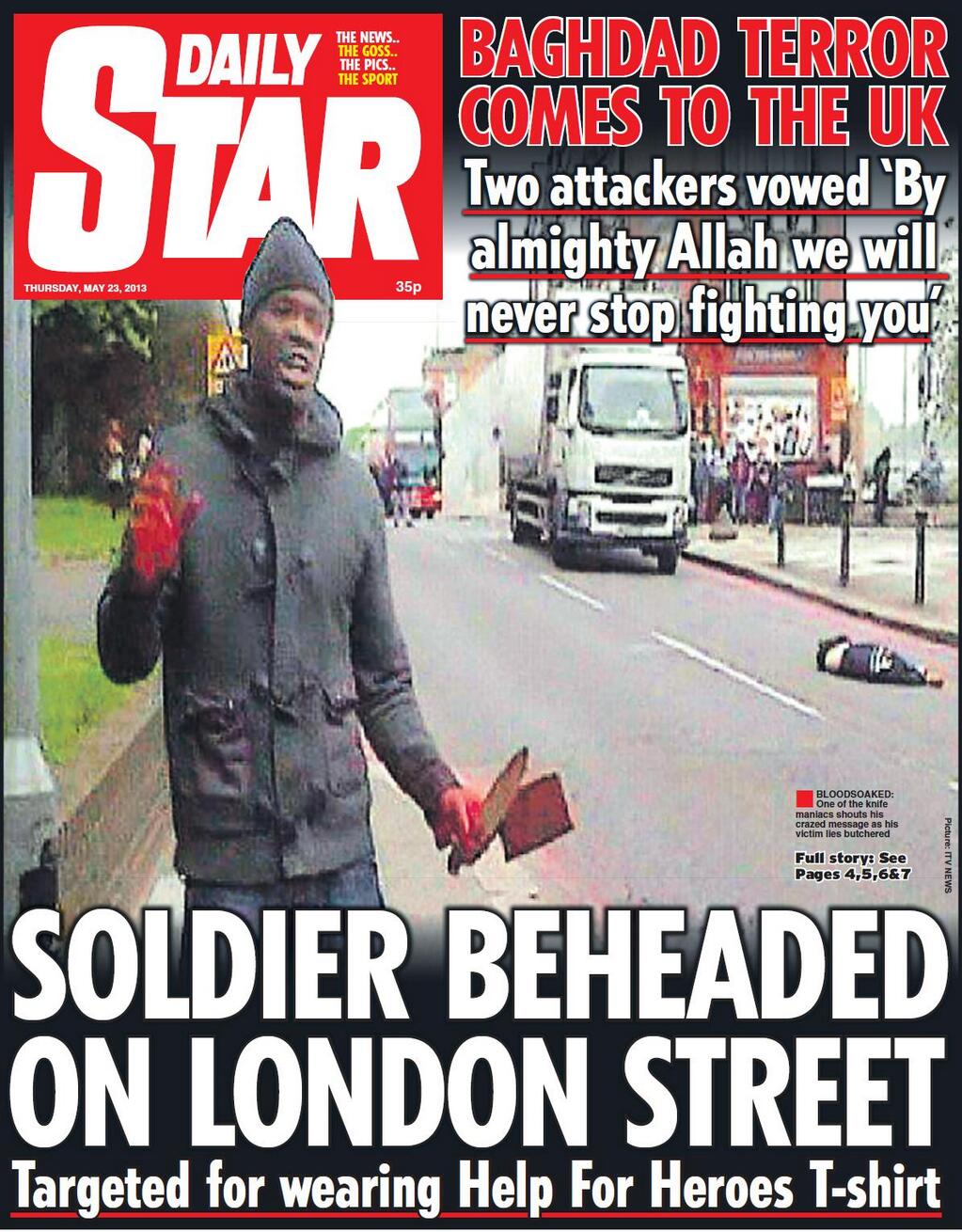
The Daily Star certainly pulls no punches. It too chooses the image that represents the story and leaves in the soldier's body, as well as the crowds and the London bus. It has no qualms in linking the attack to Iraq and says unequivocally that the victim was targeted for wearing a Help for Heroes T-shirt. 


The Daily Mail uses the image of the machete man, blown up to wipe out the front. It does not use the victim. With Mail attitude, the headline is effectively a caption: 'Blood on his hands, hatred in his eyes.' The Mail has no hesitation in linking the event with the war on the west by Islamic terrorists.


The Guardian skies the photograph of the man with the meat cleaver and crops off the victim. The London bus and crowds in the background are important for the context of this incident. The paper uses the chilling quote from the killer: 'You people will never be safe'.
 

The Independent goes for two untidily cropped square pictures of both suspects across the top and, instead of the rants from the alleged perpetrators, uses a Boris Johnson quote: 'Sickening, deluded and unforgivable'. It's difficult to argue with the sentiment.


The Indie's sister paper the i, also goes with the two pictures (off the square this time) with a characteristically straight headline.


Metro also chooses the image of the man with the machete and headlines on his chilling threat. There is a front page warning that Pages 2-5 carry graphic photographs.


The Scotsman takes a very different angle - with a photograph of the two suspects pinned to the ground by police. The headline focuses on one of the many shocking aspects - that the attackers posed for videos afterwards. 


The Daily Express knows its readership and they clearly don't want to see a bloodied man ranting at the camera minutes after committing a murder on their front page. A beaming Kate in bright yellow is, though, perhaps a little incongruous. 

All in all a strong set of pages covering a horrific event. There is nothing uplifting or positive in what happened yesterday or the way it has been reported on the front pages. There is one small positive story though. It is that of Cub scout leader Ingrid Loyau-Kennett who persuaded the attackers to hand over their weapons and kept her nerve as one of them told her: 'We want to start a war in London tonight.' The Telegraph has her story here.

Thanks as ever to the excellent , @suttonnick 

Sunday, 19 May 2013

Outlining the case for shorthand

The Sun's Graham Dudman: If you apply for a job here and you don't have shorthand your CV is going in the bin.

With everything that is changing in the media, it is reassuring to know that shorthand is still regarded as an essential tool for journalists. This is not some whim of old-fashioned editors but the recognition that there are many jobs reporters simply can't do without it. The NCTJ has put together this video which has many big-hitters from the industry putting the case for shorthand. I particularly like the quote from The Sun's Graham Dudman who says if you don't have shorthand 'it's like playing football without football boots. It's not going to happen.' He also says that if you don't have your shorthand you are 'a potential liability to your paper and we don't want you in the newsroom'.

A couple of years ago I posted the article below, which makes the case for shorthand. The NCTJ video reminded me that it is just as valid today, so worth dusting down:

Two interesting snippets are doing the rounds this week that show shorthand is still thriving at journalism training centres. First there is this quite brilliant short video Why I love Teeline posted by Julie Starr on the Evolving Newsroom and brought to my attention by@danbloom1. Then there is the story of Anneka Masih, a journalism student at Staffordshire University, who has shown her devotion to her craft by having her name tattooed on her leg ... in Teeline.
Shorthand, or more specifically Teeline, has played a big part in my life. First there were my experiences, as a trainee, in Mrs Mawston's sitting room in Whitley Bay every Wednesday afternoon.
Then, when I ran courses in Hastings, gaining 100 words per minute was essential. Some trainees were told by their editors 'don't come back unless you get it.' You can imagine the pressure. The brilliant Sylvia Bennett delivered 75-minute sessions first thing every morning followed by another hour from midday to 1pm. She had a great success rate. She still does, running the shorthand on PA Training foundation course in London as does her counterpart Susan Nixon in Newcastle. It was shorthand that dominated the last days of the course as the pressure mounted. It was shorthand that caused tears and distress. No matter how good you were at bringing in stories or penning a readable feature, if you failed shorthand your editor would be unhappy. One editor asked me to pass on this message and we put it up on the noticeboard: "If you don't have shorthand you are a liability in my newsroom. I can't send you to court or council and, in a small team, you will need to slope off for extra lessons when you should be out gathering stories. My message is simple. Get your shorthand at Hastings or don't come back." 
It always struck me that some good people were lost to journalism because of this. It is also unfair. National newspapers are littered with big name writers who have never been near a Pitman or Teeline class. Nevertheless, the industry insists shorthand is still an essential requirement. I interview trainees for the Daily Mail and you are unlikely to get over the first hurdle if you don't have  shorthand (and a driving licence). At a student conference last year Graham Dudman, managing editor of The Sun, told delegates: “Number one is shorthand. I want to know that you can write shorthand at 100wpm.”  Apart from being a required tool having shorthand also adds to your professionalism. I recall the judge who, having studied a reporter's shorthand note, advised the jury that this was not a hack but a professional man. Then there was the case of England Football manager Glenn Hoddle being interviewed by Matt Dickinson of The Times. Hoddle told Dickinson that he believed disabled people and others were being punished for their sins in a former life. In the argument that followed Dickinson's professional shorthand note was critical ... both to his reputation and Hoddle's future.
I know we can use tapes - but not always. Here's Kim Fletcher, chairman of the NCTJ, on the Today programme: “If you have a shorthand note you can find the quote very quickly. You go in with a tape recorder, or a digital recorder, and if you’ve spent an hour in there with your recorder you’ve got an hour of tape to go through, that takes quite a long time.” Journalism is changing rapidly of course and in a world of social media, video, forums, blogs,  and the like - not everyone will need to write at 100wpm.
For now though, if you are studying journalism you should learn to drive, build up a stunning portfolio, pass your law exam and GET YOUR SHORTHAND.    

Wednesday, 15 May 2013

More bills to make you smile ... and wince

Since my piece on the art of newspaper bill writing and its follow-ups here and here, I have been sent many more examples, some new and some old, but all worth an airing. So here's an update. 


One of the best recent ideas I have come across is tweeting the bills each evening, as The Northern Echo does, to encourage readers to buy the paper and visit its website. A neat transition from old print methods to the digital ways - and a simple and effective method of reaching a new audience.


Another example of creativity comes from the Nottingham Post where the bill was given a new dimension altogether. Singer/songwriter Ronika featured in the paper and online in a Q&A on her eating habits. Rather just bill it, the paper persuaded the singer to sit alongside the poster with a plate of food. The bill as performance art - certainly a new one on me.


It reflects the enthusiasm for bills by consultant editor Alan Geere who tweeted the picture above with the comment 'Still love going out to see the #bills wot I wrote and people buying the @Nottingham_Post.'


There are some good examples of ambiguous bills kicking around and this one from the Standard deserves to join the collection. I wonder if it was deliberate.


I think my favourite of the recent bills, is this from the Bristol Post. It seems like a lenient sentence to me. 


Names, particularly of famous people, will often tease people to buy so a good effort here from the South Wales Evening Post.


Animal stories sell too (just ask the Daily Mail). Here are a few worth a mention. A tortoise called Adolf? Really? Not too sure whether the animal porn story would be to many tastes - but it sounds so shocking it might just tempt someone to pick up a paper.


I can honestly say I have never seen pot-pourri used in a bill before - and in Hull of all places.


Of course the art of the bill is to tease the reader to buy. Here are a couple that might just work. The 'rub a dub dub' bill is from the Cheddar Valley Gazette. What on earth can it mean? Buy the paper to find out. That's the idea.


Sometimes bills can be so surprising and bizarre that they will turn potential readers' heads as they walk past - and that's half the battle.  


That said, I'm not sure this one would shift many papers. 


Sex, something we tend to hold at arm's length in regional newspapers, is a proven seller. These will certainly have aroused curiosity. The last one is from the Leicester Mercury.


The Argus in Brighton which brought us such classics as 'Window cleaner killed by giant pencil' and 'Crow steals golfer's trolley' appears to adopt a novelty approach to its bill writing. Although some of these may be old, they are still worth a look. The last one shows an interesting approach to positioning - a bill about a man choking to death on a kebab outside a kebab shop. 

I am a big fan of bills. Using five words to persuade some-one who wasn't going to buy the paper (or visit the website) to change their mind is a great art. Keep them coming and I'll use them in the next instalment.


Monday, 13 May 2013

Headline slip-up of the day


Not sure that 'Care home goes bananas for Fruity Friday' is really the most thoughtful headline I have ever seen - especially when the home in question 'provides residential, nursing and specialist dementia care.' Thanks to @SophieJane_E for forwarding. 


Friday, 10 May 2013

Four funny fonts films


If you are interested in typography (which you should be) and even if you think you're not, you need to watch the History of Type - an Animated Short by Ben Barrett-Forrest. It covers everything from Gutenberg's original Blackletter typeface to creating your own fonts on a computer - all in 5 minutes 10 seconds.  Brilliantly done - and funny too.


It joins my list of all time favourite typography shorts. These include the excellent tribute to Neutra Face by Lady Gaga"You can read my Neutra Face, (even when it's bold italics)" to the tune of Poker Face. Stirring stuff.


Then there is the fonts conference with typefaces given human personalities. Baskerville is 'a shrivelled bastard,' Futura a space girl and Century Gothic a modern goth with attitude. Only problem is that it's Comic Sans who saves the day. What are they trying to tell us?
This video led to my family recognising people they knew by their typographical traits. I like to think I'm a cross between Utopia Bold and Avant Garde. My kids think I'm more Goudy Heavyface and my wife definitely likes to think of me as Minion. Which one are you?


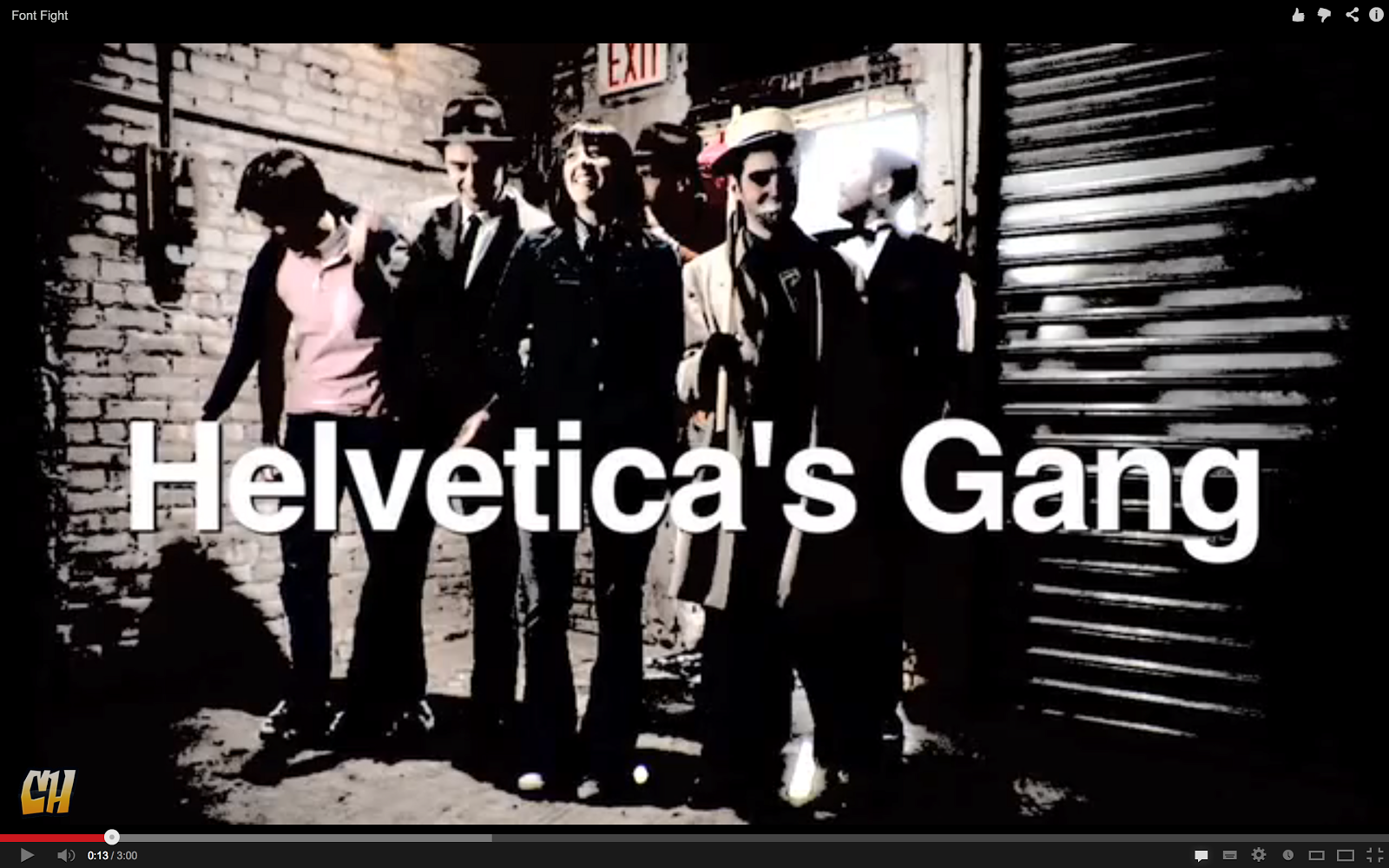
From the same stable, CollegeHumor, is the fight to the death between Helvetica's gang and Arial's gang. Watch it here.  "Arial. I haven't seen you since you cloned me and stole my identity. I've been waiting for this day for 26 years." This time, though, Comic Sans reverts to type.
It all serves as a reminder that typography isn't just for geeks ... it's fascinating and it's funny. Really.